Experience the diversity of Morocco on this 10-day road tour from Marrakech, traveling comfortably by private vehicle with a professional driver-guide. The journey takes you through spectacular landscapes, from the sand dunes of Erg Chebbi, crossed on camelback, to the dirt tracks of the Merzouga desert, as well as the majestic High Atlas, Middle Atlas, and Rif Mountains. Along the route, you will discover the lush argan fields near Essaouira, the dramatic curves of the Todra Gorges, and the stunning pre-Saharan valleys of Dades and Ziz—an unforgettable road trip that showcases Morocco’s natural and cultural beauty.
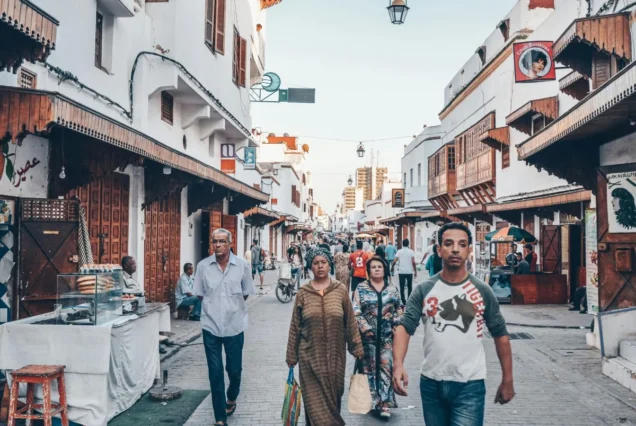
This tour also highlights the charm of Moroccan medinas, each with its unique character. Explore the largest medina in Fez, the bustling historic streets of Marrakech, the coastal atmosphere of Essaouira, the traditional desert village of Rissani, and the colorful blue medina of Chaouen. Experience the pleasure of wandering through souks, markets, squares, and historical sites like medersas and mosques, fully immersing yourself in local life. This 10-day tour from Marrakech to Tangier is meticulously designed to maximize every moment, offering a complete journey from southern deserts to northern coastlines.

Acclimatize to the country and get in touch with its main tourist city. That is the objective of this first day of the tour, which starts at Marrakech Menara Airport. Our staff will meet you at the terminal and proceed with the transfer to the riad located in the medina.
After check-in, you will have free time to stroll around the city (schedules permitting), before going to the riad’s rooms and resting.
The beauty of the Red City, which you saw in fleeting glimpses on the first day, will now be shown in all its splendor during this day. For this purpose, we will divide the day’s program in two: in the morning, guided tour; and in the afternoon, free time.
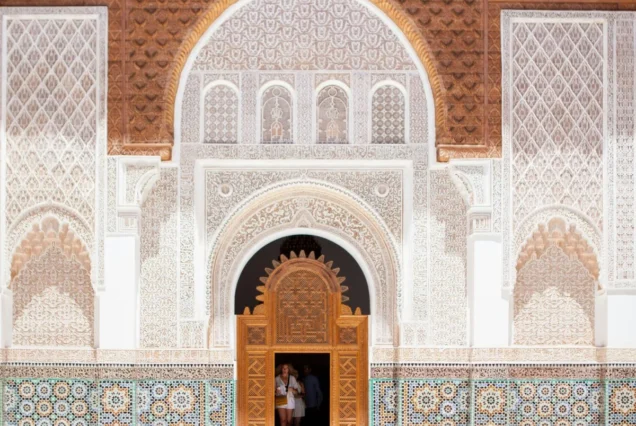
In the morning, our official guide will take you on a city tour to get a close-up look (and in some cases, inside) at the most outstanding monuments of Marrakech, whose historic medina is a UNESCO World Heritage Site. The Koutoubia Mosque is presented as the symbol of the city, the Saadian tombs are a tribute to this dynasty that ruled from this city in the sixteenth and seventeenth centuries, the Jemaa el-Fna square is a hive of life, the Bahia Palace an example of the refinement of Islamic architecture … and so on, with many other places of interest.
However, you will not have time to visit all the attractions of the city in one morning, so you can spend the afternoon at leisure visiting other museums or monuments, or shopping in the souks and stores of the medina, the Gueliz or other neighborhoods. And in the evening, you will return to rest in the riad in the medina that welcomed you the night before.
On the third day of the trip, the proposal is an excursion from Marrakech, probably the most interesting and simple: the one that will take us to Essaouira, the pearl of the Atlantic. We will drive from the riad by road along a highway through spectacular argan forests. Here there are different cooperatives that extract the precious oil, as we will see at one of the stops along the way.
Once in Essaouira, you will have free time to stroll through the medina and the maritime fortress, of Portuguese origin (16th century) and rebuilt in the time of the Alaouite sultanate (18th century). You can still recognize its ancient mellah (Jewish quarter), with an impressive Jewish cemetery. And at the foot of the Skala (citadel) there is a picturesque fishing port, which announces one of the gastronomic specialties of the city: fish, especially in tajin. And if the weather is favorable, the more adventurous can take a dip in its beaches.
In the late afternoon, we will start our way back to Marrakech, where your riad in the medina awaits you again.
On the fourth day of our trip, we left Marrakech to start our long-awaited roadtrip beyond the Atlas Mountains. Our driver will pick you up at the riad and we will head for the desert, through the mountain pass of Tizi n’Tichka: located at an altitude of 2,260 meters, the panoramic views will be spectacular during the ascent, the crest and the descent.
The first major stop of this day will be to visit Ait Ben Haddou, a fortified Berber village that can boast of being a Unesco World Heritage Site. Its hamlet huddled within high impassable walls gives it a video game or movie look. And in fact, feature films such as
Gladiator
or series such as
Game of Thrones
have set some of their scenes here. But its origin is related to the caravan routes that came from south of the Sahara and stopped here.
Our route will also stop in Ait Ben Haddou, but after the visit we will continue a few more kilometers to Ouarzazate. This city, also very cinematographic for its important filming studios, hosts the Taourirt kasbah, another magnificent example of defensive and palatial architecture in Berber style. In this case, as the residence of the Pasha of Marrakech, Thami El Glaoui. It will be the last visit before dinner and a night’s rest in the riad-hotel, located in this city.
From Ouarzazate onwards, we enter the pre-Saharan valleys, through which flow rivers with little or even seasonal flow (
wadis
) that, nevertheless, provide enough humidity to form oases of palm trees and some cultivated fields.
The Valley of the Roses is one of them, with rose bushes everywhere. The Dades Valley is another, with villages of great beauty, such as Tinghir, as well as iconic palm groves such as the one in that city or those of Tinjdad or Touroug. In one of the secondary valleys we will discover a magical place: the Todra Gorges, with rocky gorges of great height and verticality, at the base of which we can walk.
Leaving the Dades Valley we will reach the gates of the desert, specifically the city of Erfoud: its marble industry and its fossil exhibits attract the attention of those who pass through here. And soon after, in Merzouga, we will park our vehicle to continue in another much more traditional means of transport adapted to the desert: the camels.
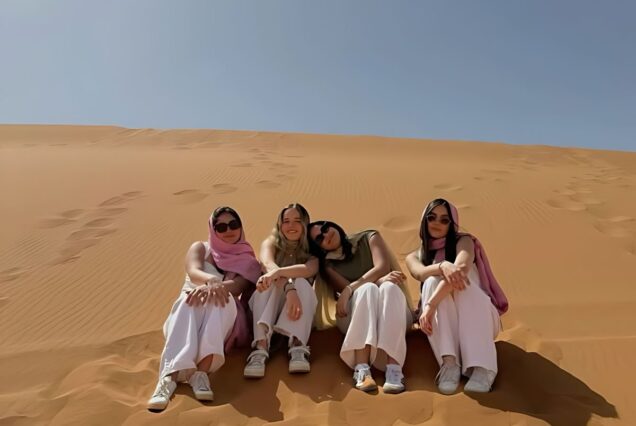
With these animals we will make an excursion through the dunes of Erg Chebbi. We will use them because of the uniqueness of the experience and because it is the best way to reach the tented camp located in the heart of the dunes. The tents are luxury tents in Berber style, and in the common areas we will enjoy a family atmosphere with tea and a fire-place. After dinner, gazing at the bright stars in the sky can be the perfect epilogue to a very intense day.
The magic of the desert lies not only in the landscapes it offers, but also in the brave and humble people who inhabit it throughout the year. And that is what we will discover on this sixth day of the circuit, but not before experiencing another unforgettable moment: the sunrise in the dunes of Erg Chebbi.
With those dreamy lights in our minds, we will return to Merzouga and start a route through other secret corners of the desert. For example, Khamlia, a small town inhabited mostly by descendants of former slaves. It is no coincidence that it is one of the cradles of Gnawa music, a folklore that we will enjoy in concert.
The asphalt road disappears a little further on, so we will get into 4×4 mode and drive along the old tracks of the Paris-Dakar rally to reach the other places of interest of the day. It will be a route full of adrenaline that runs alongside abandoned villages, kohl mines and natural geographic features.
In this way, we will arrive at our meeting with nomadic families who will welcome us for a few hours and show us their way of life: although they are in the process of sedentarization, it is still very different from the frenetic pace that prevails in postmodern society. It will be an enriching experience, which will be developed with the mediation of our driver-guide, a trusted person of these people.
After that, we will return to Merzouga, with some sporadic stops at strategic points, with panoramic views of the dunes and the desert. We will conclude the day with dinner and a night’s rest in a stylish and charming hotel.
Our route, on this seventh day, leaves the desert and takes us back to the north of the Atlas. We will return to the asphalt and make a first stop in Rissani, a small town with a historic medina of the most authentic, as evidenced by the prints that can still be seen in it: walls, a historic mausoleum for the Moroccan monarchy, a market of food and products of all kinds … and even a parking lot for donkeys.
After visiting this city, the road takes us north through the Ziz Valley, which we will go all the way up to the Middle Atlas. This stretch of mountain range is not the highest but it is the wettest and greenest, as we will discover when we move to the north face. This is precisely where the Ifrane National Park is located, popularly known as the Monkey Forest or the Cedar Forest, due to the large number of these animals and these trees, iconic of the country.
On our descent to Fez we will also pass through Ifrane, a town that will draw attention for its resemblance to the mountain villages in Europe and North America, with gable roofs to protect from the snowfall and heavy rains that fall here.
In Fez, we will check-in at the riad in the medina where you will spend the night and the next day.
Fez is a city very dear to all Moroccans: it is the spiritual, cultural and scientific capital of Morocco, and in the past it was also the administrative capital. That is why its medina is so large and preserves buildings of great interest, which has also earned it the title of World Heritage Site by UNESCO.
To get to know it in depth, there is nothing better than a guided tour with a professional certified by the Ministry of Tourism. In his urban tour he will tell us about the division of the medina into Fez el Jedid and Fez el Bali, its Andalusian quarter, its artisan souks, its prestigious medersas and even the Karaouine mosque, which houses what is considered the oldest university in the world. Our ‘cicerone’ will decide which squares and streets to walk through and which buildings to enter to better appreciate the beauty of this historic medina.
Other worthwhile areas that can be visited in the afternoon are the mellah, the esplanade of the Royal Palace with its magnificent golden gates or some museums of interest such as the Dar Batha or the Borj Nord. And if you are interested in traditional handicrafts, this is the best city to buy local products, be it jewelry, leather goods, wooden pieces, pottery, basketry or any other handmade object.
Undoubtedly, there are many things to do in Fez before returning to the riad to rest for the night.
On this penultimate day of the circuit, we continue traveling north, in this case to discover one of the most picturesque villages of the country: Chaouen. It is located less than 200 km from Fez and your visit will be impressed by its beautiful medina, whitewashed and painted in light blue. That is why they call it the ‘blue city’.
In addition, its location on the slopes of two mountains in the form of horns has favored the existence of viewpoints, where you can go to take panoramic photographs. The visit of Chaouen will be free, but your tour should not miss the square of Uta el-Hammam, where there is also the medieval kasbah, now the Ethnographic Museum.
To complete this day with its characteristic atmosphere, you will rest in a charming riad in the heart of the medina.
This 10-day circuit comes to an end on this tenth day, when we will reach the northern tip of the country: from the riad in Fez we will make the direct transfer to Tangier Ibn Battuta Airport, leaving with enough time to arrive calmly at the boarding terminal. Here our services will end, with the hope of having fulfilled the expectations of a trip as complete and intense as this one.